
The summer of 2026 has brought severe drought and exceptionally low water levels to parts of the Danube River Basin (DRB), highlighting the vulnerability of water resources, ecosystems and water-dependent sectors across Central and Eastern Europe.
The situation is not uniform across the basin. Its impacts vary from declining soil moisture, groundwater levels and river flows to severe low-water conditions affecting navigation, agriculture, energy production, tourism and freshwater ecosystems.
Yet the underlying message is shared: drought does not follow administrative borders, and water resilience cannot be built by countries or sectors acting in isolation.
A basin under increasing water stress
Drought develops across different parts of the water cycle and can therefore have consequences that are not immediately visible.
In 2026, these conditions have become particularly visible in several parts of the Danube River Basin. Through partners in our network of Country Water Partnerships in the region, we have collected and exchanged recent information, lessons and data on the situation — and for some countries, this is summarised below.
Slovenia: drought across the water cycle
In Slovenia, the drought situation has been worsening following a prolonged period with little or no precipitation combined with high temperatures.
The impacts are visible across several components of the water cycle:
- soils are drying out;
- river flows are below normal for the time of year;
- groundwater levels are declining; and
- some smaller springs have already dried up.
The Slovenian Environment Agency (ARSO) has assessed the situation as hydrological drought, with challenging conditions expected to continue. Slovenia monitors the situation through the ARSO Sušomer, which provides weekly assessments of agricultural, surface-water and groundwater drought and incorporates short-term forecasts. This illustrates an important aspect of drought management: effective response depends on monitoring changes across the entire water cycle rather than focusing on river levels alone.
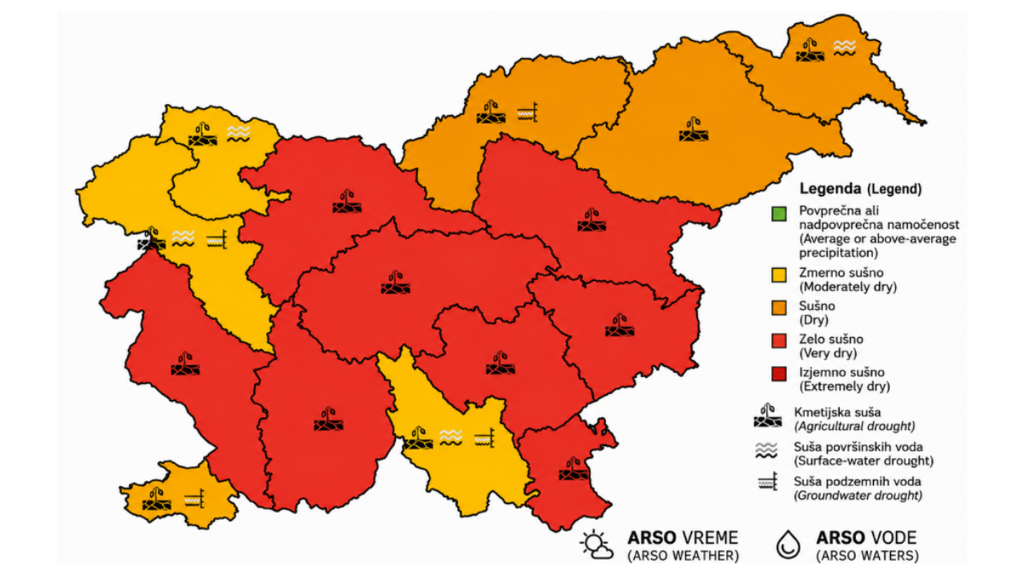
National report on the state of the drought in Slovenia, 13.08.2026 (AI translated)
Hungary: declining water reserves in the Tisza Basin
The Hungarian part of the Tisza River Basin has experienced an exceptionally severe drought and low-water situation during summer 2026.
Very low river discharges, limited water replenishment, prolonged precipitation deficits and intensified evaporation have combined to reduce water availability.
Despite preventive measures taken during the preceding autumn and winter — including maintaining higher-than-usual operational water levels in regional canal systems and Lake Tisza — water reserves have continued to decline.
The consequences are increasingly important for drinking-water supply, irrigation, ecological needs and other water uses. A key priority is maintaining the continuous operation of water intake facilities serving approximately 100,000 people in the Szolnok area and more than 120,000 people in the Debrecen area. Regional water directorates are therefore applying coordinated water-resource management, including careful operation of the Kisköre and Tiszalök dams, water distribution through the Tisza–Körös-valley Coordinated Water Management System, prioritisation of essential water uses and restrictions on lower-priority abstractions where necessary.
The Hungarian experience also demonstrates the value — and the limits — of water retention. Building reserves before the dry season can strengthen resilience, but prolonged drought and high evaporation can still place water systems under severe pressure.
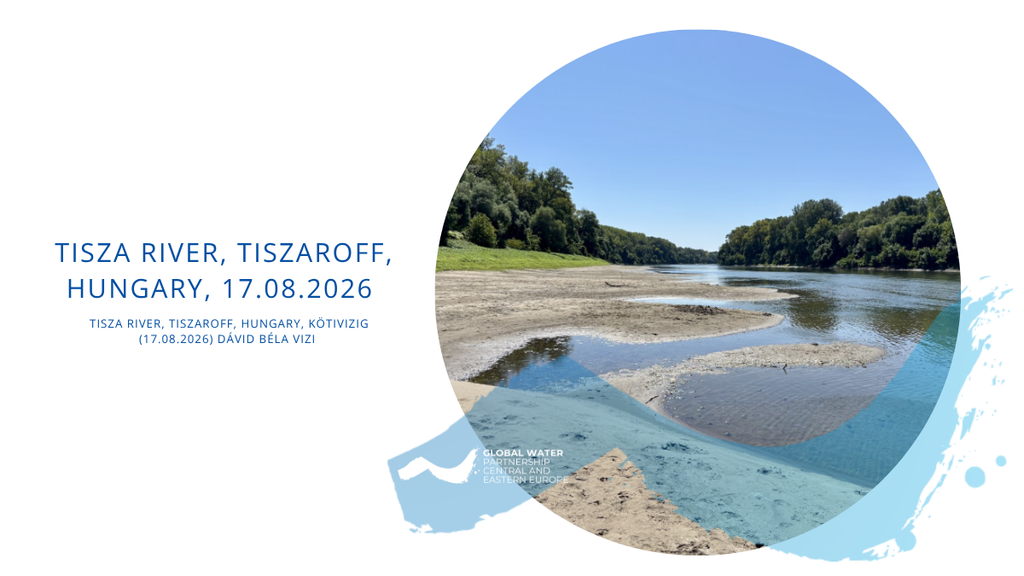
Picture 1: “Photo of Tisza River at Tiszaroff, Hungary, 17 August 2026. Photo: KÖTIVIZIG/ Dávid Béla Vizi “
Slovakia: exceptionally low Danube flows in Bratislava
In Slovakia, the summer of 2026 brought exceptionally dry conditions to the Danube. According to the Slovak Hydrometeorological Institute (SHMÚ), July 2026 recorded historically low Danube flows in Bratislava, including the lowest average monthly discharge for July in the measurement record. The unusually low water levels have visibly exposed riverbanks and shallow areas.
While these changes may appear local, the Danube is a transboundary river system connecting countries, communities, ecosystems and economies along its entire course. Low flows in one section of the river are part of a much wider basin-scale water balance. This makes hydrological monitoring and the exchange of timely information between countries particularly important during drought episodes.
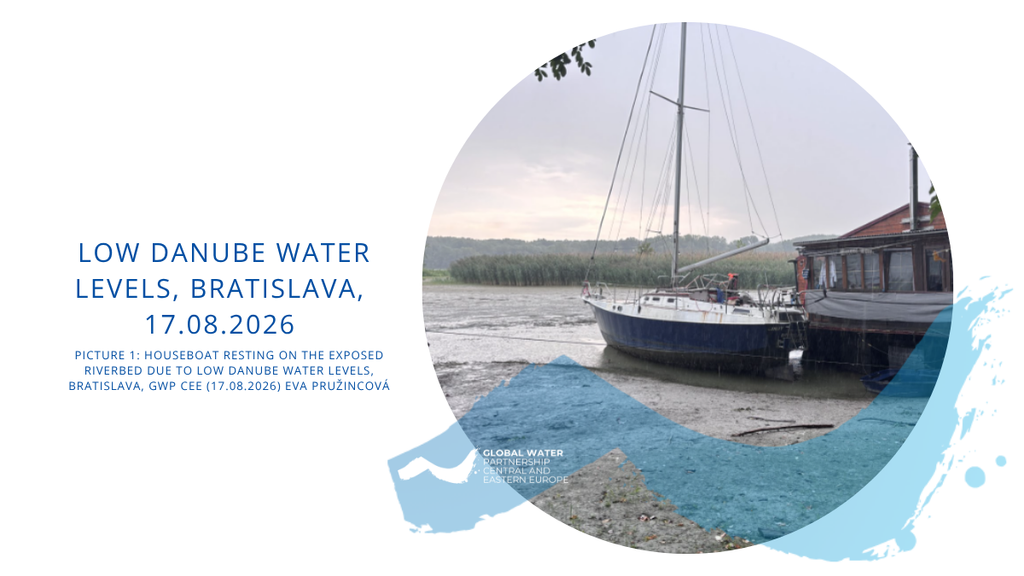
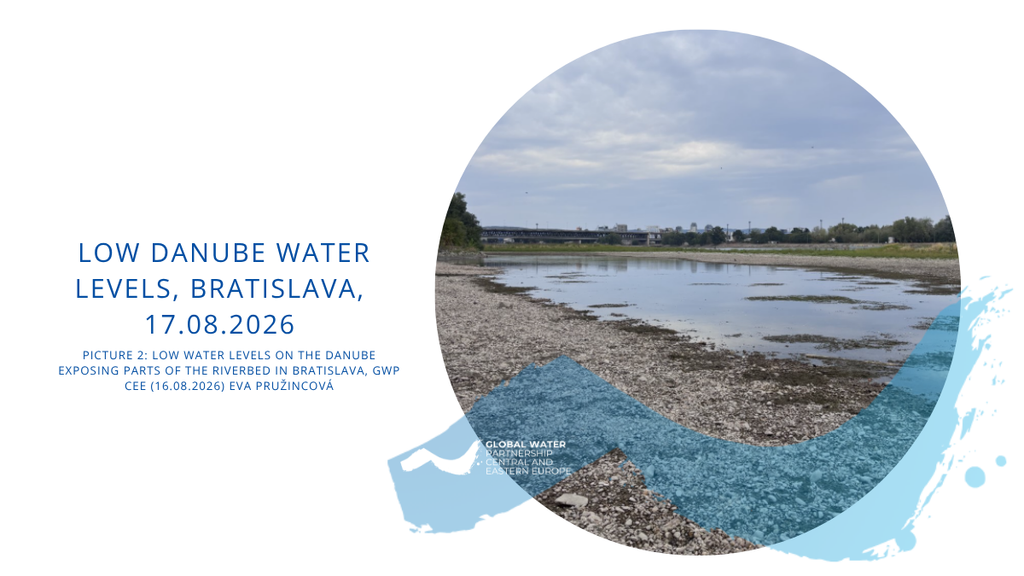
Picture 1 and2: “Low water levels on the Danube in Bratislava, Slovakia, 17 August 2026. Photo: GWP Slovakia / Eva Pružincová”
Romania: when low river flows become a cross-sectoral crisis
The impacts of the 2026 low-water episode have been particularly visible along the Romanian Danube.
According to the National Institute of Hydrology and Water Management (INHGA), on 18 August the discharge at Baziaș was approximately 1,350 m³/s, compared with a long-term August average of around 3,900 m³/s — approximately 35% of the average. Forecasts at the time indicated that discharge would remain around 1,300–1,350 m³/s, with a generally slight decrease downstream of the Iron Gates. Measurements published by the Lower Danube River Administration (AFDJ Galați) also showed very low water levels along much of the Romanian sector.
The consequences were felt across multiple sectors:
- Energy: Low Danube water levels contributed to the controlled shutdown of units at the Cernavodă Nuclear Power Plant. The units were maintained in a safe shutdown state, with no impact on nuclear safety, the public or the environment. The episode demonstrated how river conditions can become directly relevant to energy security.
- Navigation and logistics: Low water levels reduced navigable depths and required vessels to operate with reduced draughts and cargo loads. Barges and convoys were reported stationary in the Giurgiu–Ruse area, while authorities continued to publish information on critical locations and minimum depths.
- Agriculture: Low river discharges, high temperatures and limited water availability increased pressure on irrigation and agricultural production.
- Tourism: River cruise operators reported cancellations and changes to itineraries, illustrating the economic consequences of low-water events for river-based tourism.
- Ecosystems: Warm water, low volumes and slow flow can increase the risk of oxygen depletion and the isolation of aquatic habitats. In the Lower Danube, these conditions create additional pressure on aquatic fauna and connected riverine ecosystems.
Romanian authorities responded through intensive hydrological monitoring, forecasts, navigation measures and emergency interventions aimed at maintaining essential water flows.
Bulgaria: low water levels affecting energy, navigation and water quality
The decline in the Danube water level in the Bulgarian section has affected river navigation, with shipping operations facing significant restrictions and disruptions. Reduced navigability has economic consequences for the transport of goods by water, while tourism activities have also been affected, with some journeys and activities shifting to land-based transport.
The situation has also affected the energy sector. Due to the continued and critical decline in the Danube water level, the Kozloduy Nuclear Power Plant introduced a preventive reduction to ensure the plant’s safe operation.
At the same time, low river flows may pose additional challenges for water quality. Reduced water volumes can decrease the river’s capacity to dilute wastewater entering the Danube, potentially increasing pressure on water quality and creating concerns about possible impacts on coastal wells used for drinking-water supply.
These interconnected impacts illustrate how a low-water event can quickly extend beyond the river itself.
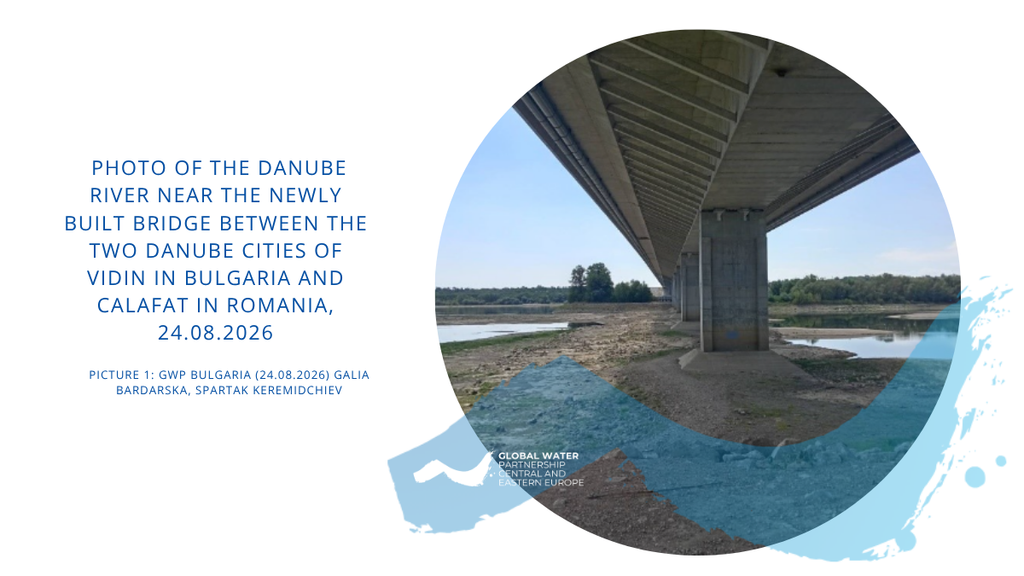
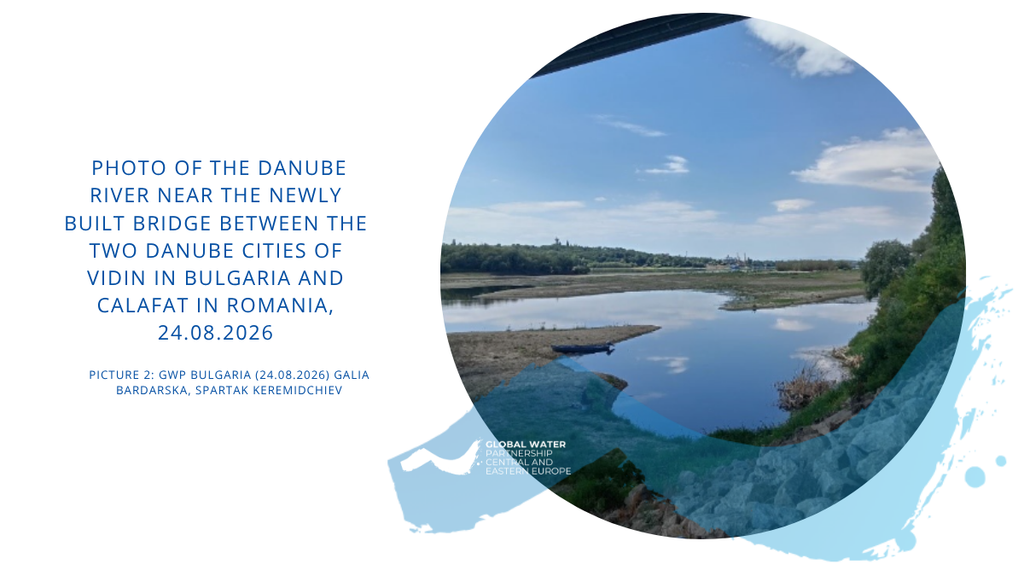
Picture 1 and2: “A photograph of the River Danube near the newly built bridge between the two cities on the Danube: Vidin in Bulgaria and Calafat in Romania, Bulgaria, 24 August 2026. Photo: GWP Bulgaria/ Spartak Keremidchiev”
GWP CEE’s role in advancing regional drought management
This kind of cross-border cooperation is not new territory for GWP CEE. Since 2013, GWP CEE has coordinated the Integrated Drought Management Programme for Central and Eastern Europe (IDMP CEE), part of the joint GWP/WMO global drought programme, working with more than 40 partner organisations across the region — built on the network of national Country Water Partnerships. Through this work, and through related efforts such as the Danube Drought Strategy developed under the DriDanube project, GWP CEE has supported national dialogues, shared monitoring tools, and contributed regional expertise to bodies such as the ICPDR’s work on droughts and low water levels in the Danube basin. The 2026 drought is a reminder of why that long-term, cooperative groundwork matters.
Taken together these national experiences show that drought is never a single-sector problem – it moves through water resources, agriculture, energy, transport, ecosystems and communities all at once. Recent observations across Europe reinforce this wider picture: severe summer drought has affected rivers, lakes, agriculture and aquatic ecosystems across several countries, while low Danube levels have also disrupted energy production and navigation.
From emergency response to long-term resilience
The 2026 drought episode also raises an important question: how can the Danube Basin become more resilient before the next drought arrives?
Emergency interventions are essential when critical thresholds are reached. However, long-term resilience requires a broader approach.
Key priorities include:
- strengthening drought monitoring and early-warning systems;
- improving the exchange and accessibility of hydrological data;
- strengthening cooperation between Danube countries;
- integrating water management across sectors;
- protecting and restoring natural water-retention areas;
- improving water-use efficiency, particularly in agriculture;
- planning critical infrastructure with future water availability in mind; and
- developing drought-management measures before crises emerge.
The need for integrated planning is particularly important because measures taken in one sector can affect another. Water retained for one purpose may not be available elsewhere, while interventions designed to maintain navigation or energy production may have ecological consequences.
A resilient basin therefore requires coordination rather than isolated responses.
The Danube is one connected system
The 2026 drought demonstrates the importance of looking beyond national boundaries.
The Danube River Basin is a shared system. Water availability upstream influences conditions downstream, while climate and hydrological changes affect multiple countries at the same time.
This makes cooperation, data exchange and coordinated planning essential.
The objective should not simply be to manage the next low-water event.
It should be to build a basin that is better prepared for a future in which droughts and water scarcity may become more frequent, more intense or more difficult to predict.
The 2026 drought is a warning — but also an opportunity to strengthen water resilience across the Danube River Basin.
Sources and methodology
This article is based primarily on information, data and observations provided to GWP CEE by Country Water Partnerships (CWPs) across the region as part of regional information exchange on drought and low-water conditions in 2026. Where available, information was complemented and cross-checked with publicly available data and information from national authorities, hydrometeorological services and other relevant institutions.
Information provided by GWP Country Water Partnerships
Country reports and updates provided to GWP CEE by:
- GWP Slovakia
- GWP Slovenia
- GWP Hungary
- GWP Romania
- GWP Bulgaria
The information reflects conditions and developments reported by the respective Country Water Partnerships at the time of preparation of this article.
External sources and further reading
Slovakia:
Slovak Hydrometeorological Institute (SHMÚ). “Historický júl na Dunaji v Bratislave” 14 August 2026. [ https://www.shmu.sk/sk/?page=2049&id=1773 ]
Slovenia:
Slovenian Environment Agency (ARSO) – Drought Monitor. “Sušomer” 18 August 2026.
[https://meteo.arso.gov.si/uploads/probase/www/agromet/bulletin/drought/sl/?utm_source=chatgpt.com ]
Romania:
National Institute of Hydrology and Water Management (INHGA). “Hydrological diagnosis and forecast for the Danube at the national border and along the Romanian sector: Romania – Danube diagnosis and forecast ” 18 August 2026.
[https://www.hidro.ro/bulletin/diagnoza-si-prognoza-hidrologica-pentru-dunare-la-intrarea-in-tara-si-pe-sectorul-romanesc-18-08-2026/]
Nuclearelectrica. “ Information on the controlled shutdown of Unit 2 at Cernavodă Nuclear Power Plant“ 13 August 2026. [Nuclearelectrica, controlled shutdown of Unit 2, 13 August 2026; Radio Romania News, navigation, 7 August 2026; RRA, tourism, 8 August 2026; RRA, ecological impact, 9 August 2026 ]
AFDJ Galați – Lower Danube River Administration“ Romania – Danube water levels “ 20 August 2026. [https://afdj.ro/ro/cotele-dunarii]
Bulgaria:
Information and country update provided by GWP Bulgaria to GWP CEE, August 2026.
Hungary:
Central Tisza Region Water Directorate “ Drought and water-management measures in the Tisza River Basin“ 18. August 2026. [https://www.kotivizig.hu/en]